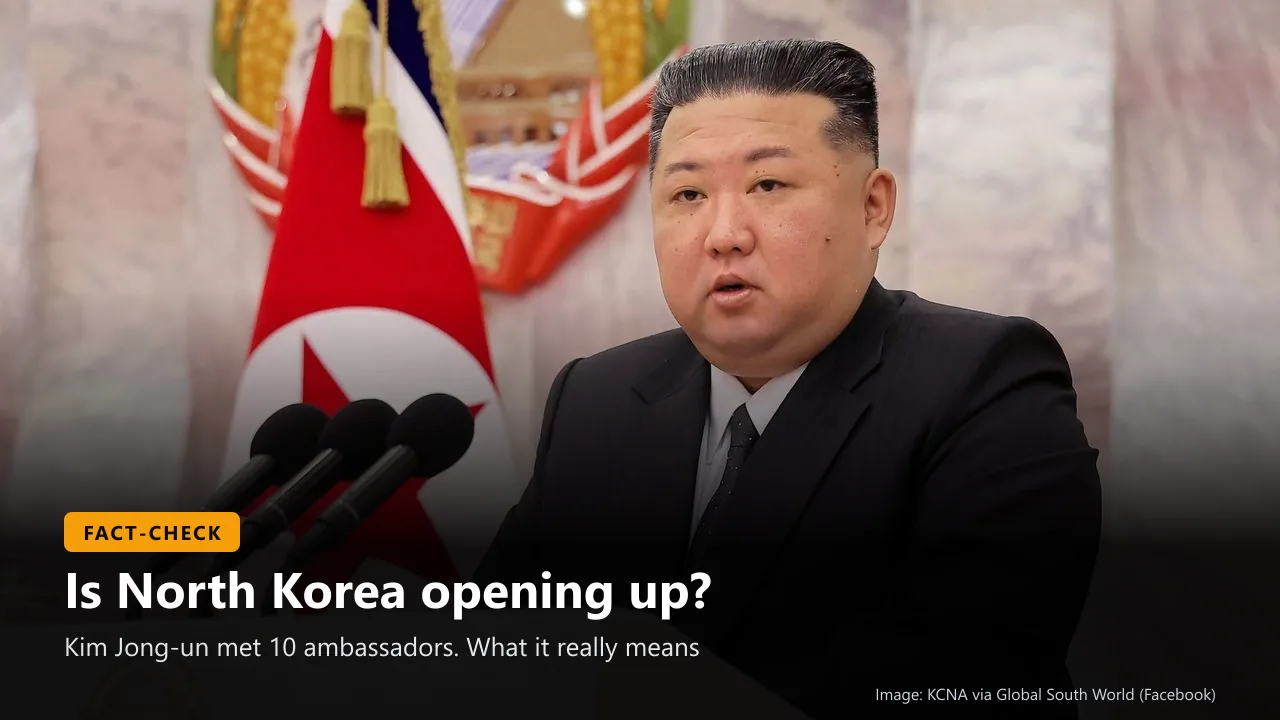
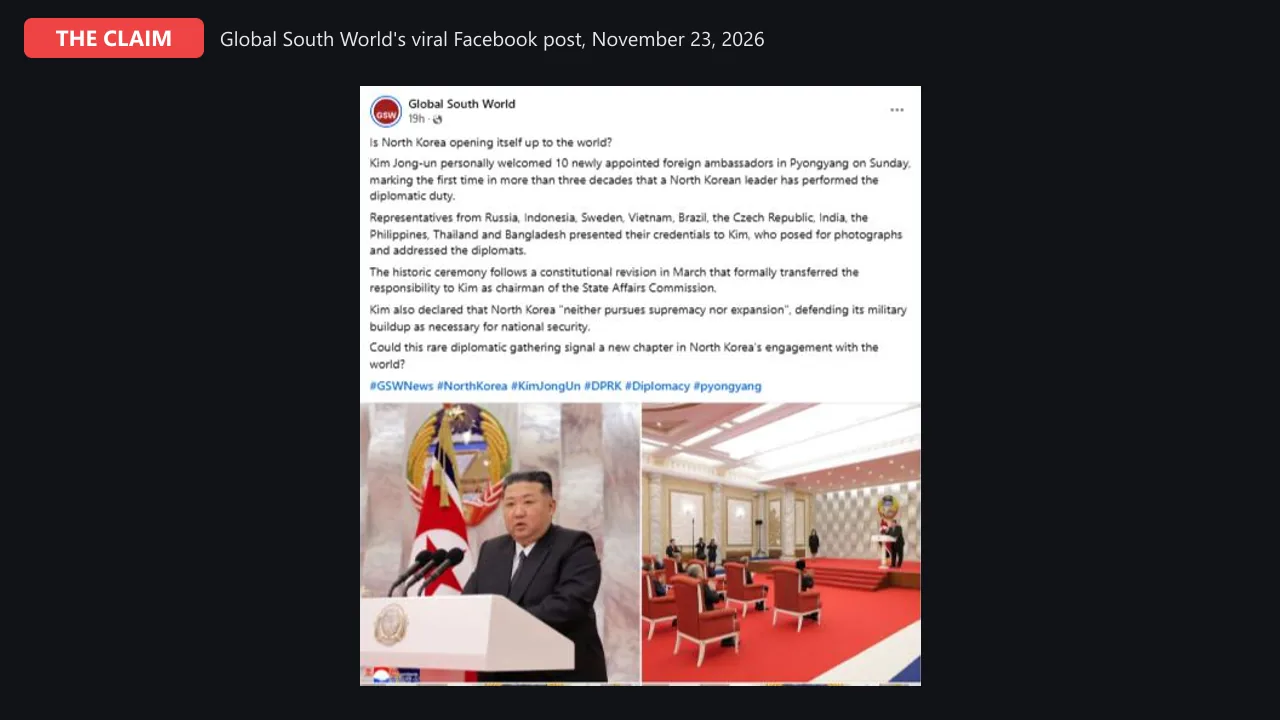
The facts in the viral post are right: on Sunday, November 22, 2026, Kim Jong-un personally received the credentials of 10 newly appointed foreign ambassadors in Pyongyang, the first time a North Korean leader has done that in more than 30 years. What's less certain is the post's big question. Analysts and South Korea's government see the ceremony mainly as a way to show Kim as North Korea's head of state, not as a sign the country is opening up.
The claims, checked
"Kim Jong-un personally welcomed 10 newly appointed foreign ambassadors on Sunday." True.
North Korea's state news agency KCNA reported the ceremony on November 23. The Russian Embassy in Pyongyang said on Telegram that Ambassador Andrei Podelyshev presented his credentials to Kim that Sunday, The Korea Times reports.
"The first time in more than three decades a North Korean leader has performed the duty." True.
Kim's grandfather, national founder Kim Il-sung, received ambassadors' credentials himself. Under his father, Kim Jong-il, the job passed to the head of the Standing Committee of the Supreme People's Assembly, the parliament's top official, and it stayed there until now.
The 10 countries. True.
The new ambassadors came from Russia, Indonesia, Sweden, Vietnam, Brazil, the Czech Republic, India, the Philippines, Thailand and Bangladesh. One detail many readers miss: Sweden's embassy also looks after US citizens in North Korea, because the United States has no embassy there.
"It follows a constitutional revision in March." True.
The March revision gave the chairman of the State Affairs Commission, the post Kim holds, the power to receive foreign ambassadors' credentials.
"Kim declared North Korea neither pursues supremacy nor expansion." True, with a translation caveat.
Other English reports render his words as North Korea "seeks neither hegemony nor expansion". He also said coercion and pressure have no place in its foreign policy, The Korea Herald reports. We couldn't find his exact words on the military build-up in independent reports.
So, is North Korea opening up?
Probably not in the way the post suggests. Receiving ambassadors' credentials is a routine job for a head of state in most countries. South Korea's Unification Ministry said the ceremony appeared meant to reinforce Kim's status as head of state, at home and abroad, and observers quoted by The Korea Times read it the same way: as Kim exercising his authority directly in diplomatic protocol.
There are some real signs of more diplomacy: Kim vowed to expand foreign ties at the ceremony, and several of the 10 countries are major partners in Asia and Europe. But none of the new envoys came from the US, UK, Japan or South Korea, there's no sign of change to North Korea's nuclear weapons programme, and the country's borders and media remain among the most closed in the world.
Why this matters
- Protocol is political: in North Korea, who performs a ceremony signals who holds power. Moving the role to Kim formally puts him in the place of a president.
- The guest list is telling: Russia's embassy was the first to announce it, reflecting the two countries' close ties since their 2024 mutual defence treaty.
- Images come from the state: the photos in the post were released by North Korean state media, which controls how such events are shown.
Questions people ask
Why didn't Kim Jong-un receive ambassadors before?
Under the system his father set up, the head of the parliament's Standing Committee did it as the nominal head of state. The March constitutional change moved that role to Kim.
Does the US have an ambassador in North Korea?
No. The US has no diplomatic relations with North Korea; Sweden acts as its protecting power in Pyongyang.
For more viral posts we've checked, see our fact-checks of the "$3 trillion in 10 minutes" Nvidia rally and the "GTA 6 PC exe" Leonida post.