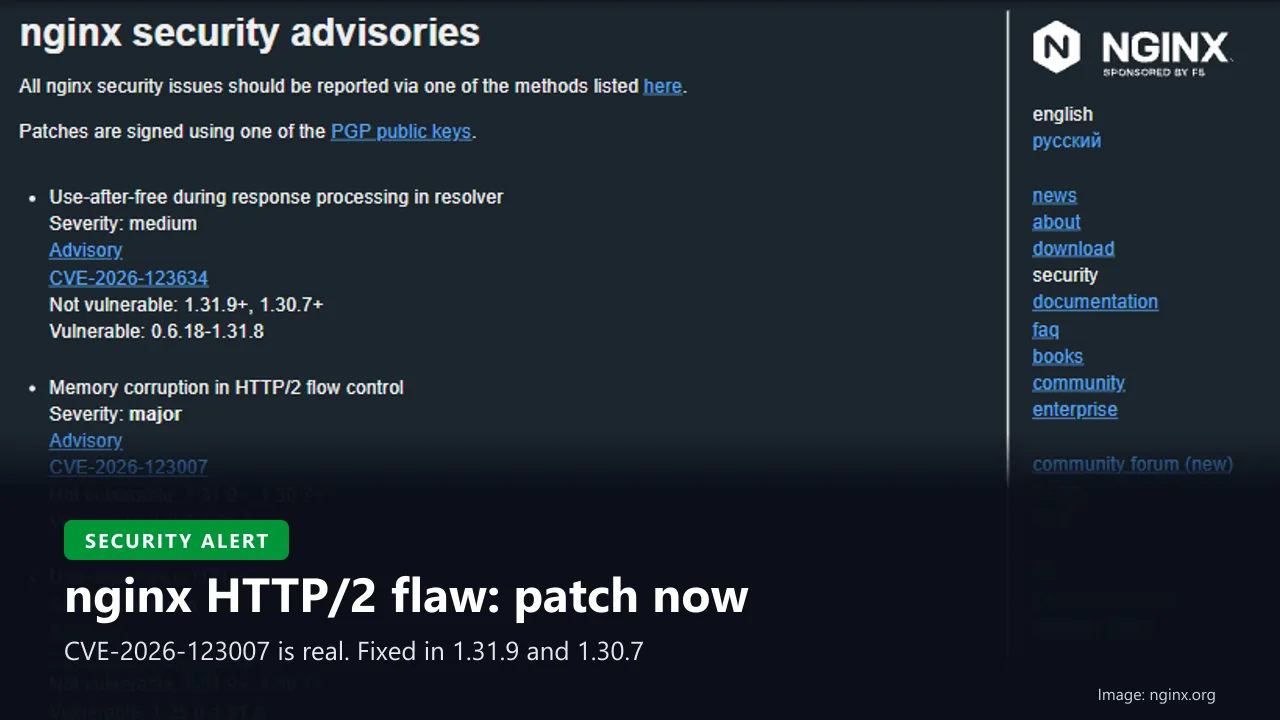
Yes, the warning going around social media is real. On November 18, 2026, nginx's maintainers and F5 disclosed CVE-2026-123007, a flaw in nginx's HTTP/2 code that can let an attacker who never logs in run code on a web server. Any server running nginx 1.9.5 to 1.31.8 with HTTP/2 turned on is exposed, even one that only serves static files. The fix is nginx 1.31.9 or 1.30.7. If you can't upgrade yet, turning off HTTP/2 blocks it.
Viral posts, including ones shared in Facebook tech groups, get the main points right. What they leave out is that patches already exist, that the known attack is hard to pull off, and that no real-world attacks had been reported at disclosure. Here's the full picture.
The claims, checked
"A dangerous flaw was found in nginx." True.
nginx's security advisories page lists "Memory corruption in HTTP/2 flow control" (CVE-2026-123007) with severity "major", and Rapid7 rates it 9.2 out of 10, critical, on CVSS 4.0. The bug sat in the code for about ten years: it arrived in nginx 1.9.5 in September 2015. Researchers call the set of flaws "nginx2root".
"Attackers can run code remotely without logging in." True, with limits.
According to Rapid7, nginx can miscalculate how much response data an HTTP/2 client has allowed it to send. A client can abuse that to corrupt memory and run code with the permissions of an nginx worker process. That's not full control of the machine: CIRCL notes that getting root needs a second bug, and the researchers at Xint paired it with a separate Linux kernel flaw to do that, even from inside a Docker container.
"Even a server serving only static files is at risk if HTTP/2 is on." True.
The only requirement is HTTP/2 enabled on an affected listener, CIRCL says. You don't need a proxy, PHP or any special module.
"Turning off HTTP/2 stops it for now." True, but patching is the real fix.
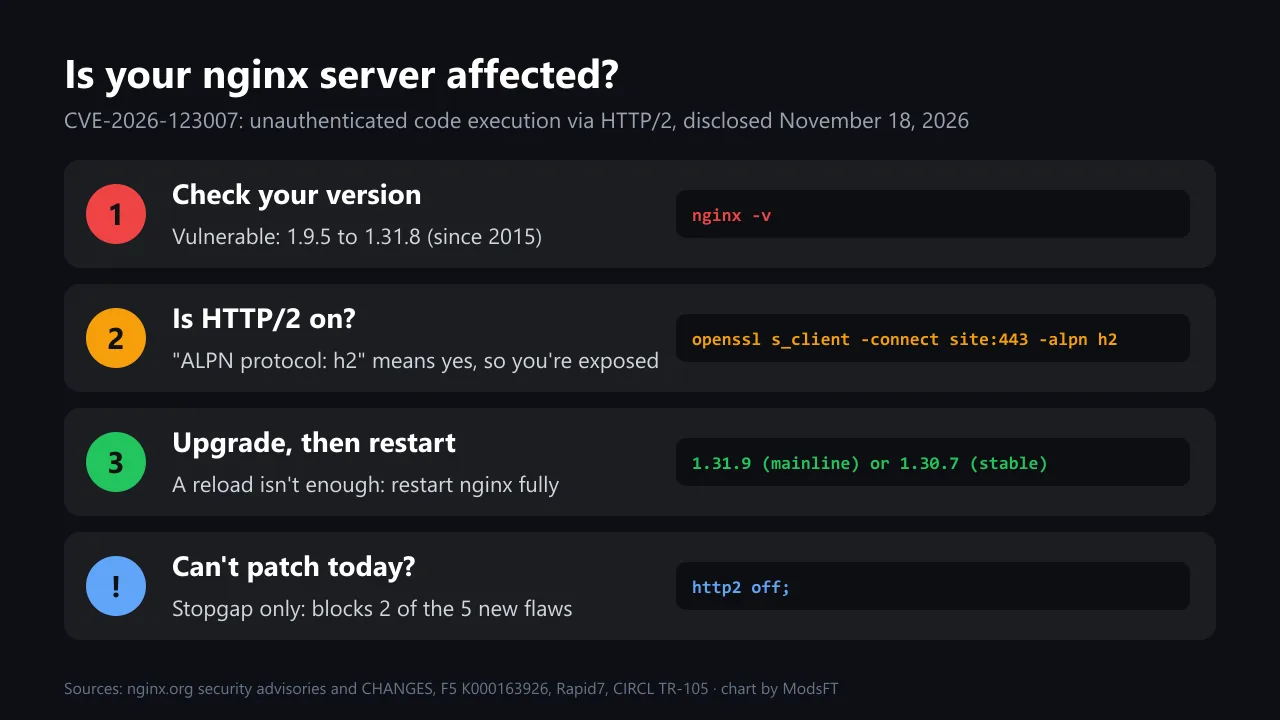
Disabling HTTP/2 blocks this flaw and a second HTTP/2 bug, CVE-2026-123633. It doesn't fix the other flaws patched the same day, so upgrade as soon as you can.
Which nginx versions are affected?
- nginx Open Source 1.9.5 to 1.31.8 is vulnerable. That includes the October security releases 1.31.7 and 1.30.6.
- Fixed: 1.31.9 (mainline) and 1.30.7 (stable), both released November 18, per nginx's change log.
- NGINX Plus: fixed in 37.3.0.1 and 37.0.8.1; see F5's advisory K000163926.
- Servers that only speak HTTP/1.1 aren't affected by this flaw.
How to check if your server is exposed
First, check the version:
nginx -vThen check whether the server accepts HTTP/2. Replace example.com with your domain:
openssl s_client -connect example.com:443 -alpn h2If the output includes ALPN protocol: h2, HTTP/2 is on. In your config, look for http2 on a listen line or an http2 on; directive. If your site sits behind a CDN such as Cloudflare, test the nginx origin server directly, because that's what an attacker would target.
How to fix it
- Upgrade to nginx 1.31.9 or 1.30.7, or install your Linux distribution's patched package. The official Docker images have 1.31.9 and 1.30.7 tags.
- Restart nginx fully, for example
sudo systemctl restart nginx. A reload can leave old worker processes running the vulnerable code. - Confirm with
nginx -v, or check your package version against your distribution's advisory.
Distribution packages often carry the fix without changing the version number nginx -v shows. Debian fixed Debian 13 (trixie) in DSA-6642-1, while its security tracker still listed Debian 12 (bookworm) as vulnerable when we checked on November 20. Check Ubuntu's CVE page for your release.
Can't upgrade yet? Turn off HTTP/2
On nginx 1.25.1 and later, add this to each affected server block and remove http2 from its listen lines:
http2 off;On older versions, remove http2 from the listen directive, for example change listen 443 ssl http2; to listen 443 ssl;. Then test the config with sudo nginx -t and restart. Visitors will fall back to HTTP/1.1, which can be slightly slower on busy pages but works with every browser.
How dangerous is it in practice?
It's serious, but not a "the whole internet falls over tonight" bug:
- Rapid7's attack needs a lot of traffic: about 128 GB of HTTP/2 data. That took two and a half minutes in its demo, and Rapid7 estimates 17 minutes on a 1 Gbit/s link. Below roughly 300 Mbit/s, nginx's default one-hour connection limit cuts the attack off.
- A proxy in front helps: if HTTP/2 is passed through another proxy, the exact frames the attack needs probably won't reach nginx intact, Rapid7 says.
- ASLR isn't a shield: F5 says code execution needs ASLR off or bypassed, but CIRCL warns the researchers documented ways to bypass it, so don't treat ASLR as a substitute for patching.
- No attacks seen yet: at disclosure, neither F5 nor the researchers had reported real-world exploitation. But proof-of-concept code is public on GitHub, so that can change quickly.
The other flaws fixed the same day
nginx 1.31.9 and 1.30.7 fix several more security bugs, including CVE-2026-123633 (HTTP/2 use-after-free), CVE-2026-121810 (HTTP/3), CVE-2026-123634 (DNS resolver), CVE-2026-113425 (mail proxy) and CVE-2026-118899 (an endless loop over TLS 1.3). Upgrading covers all of them; turning off HTTP/2 doesn't.
Do regular users need to do anything?
No. This is a server bug, so there's nothing to install on your phone or PC. It's for people who run websites, VPS servers, Docker containers or Kubernetes ingress controllers built on nginx. If your site is on managed hosting, ask your host whether it has patched. For other recent security news, see our explainer on AI agents escaping sandboxes and the WorkOS breach.
Questions people ask
Is Apache or Caddy affected?
No. CVE-2026-123007 is a bug in nginx's own HTTP/2 code, so it doesn't affect other web servers.
I use Cloudflare. Am I safe?
Not automatically. A CDN talks to your origin over its own connection, so what matters is whether your nginx origin accepts HTTP/2 and can be reached directly from the internet. Test the origin as shown above and patch it.
Why is it called nginx2root?
Xint, one of the research teams, named the set of five nginx flaws that, combined with a separate Linux kernel bug, could lead from a web request to root access on the host.